
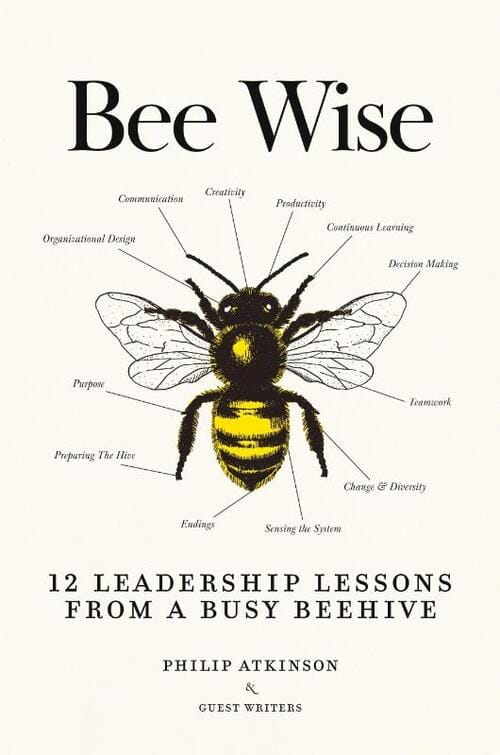
Responses to the talk Bee Wise – Life Lessons from Inside a Beehive on 9th April 2026.
An unexpected concept, to relate the lives of bees to our human existence. There is also so much I don’t know about bees, the subject being immense. I look forward to reading my free copy of Bee Wise which Philip so generously gave us. His enthusiasm certainly came over to me. – Ann M.
It was delightful. Philip could have spoken for at least another hour. Knowing nothing about bees and beekeeping myself, I left full of questions. Please invite him back! – Susan P.
An interesting topic. I was hoping for a bit more structure in his talk. He mentioned some of the duties of bees but didn’t explain them. I suppose he wanted to use them as examples of what good communications within a team could be etc. I wasn’t quite sure what the point of the overhead projections was… but still, I found some of the aspects thought-provoking. We can reflect on the social and communicative behaviours of bees in relationship to our own. – Michelle S.
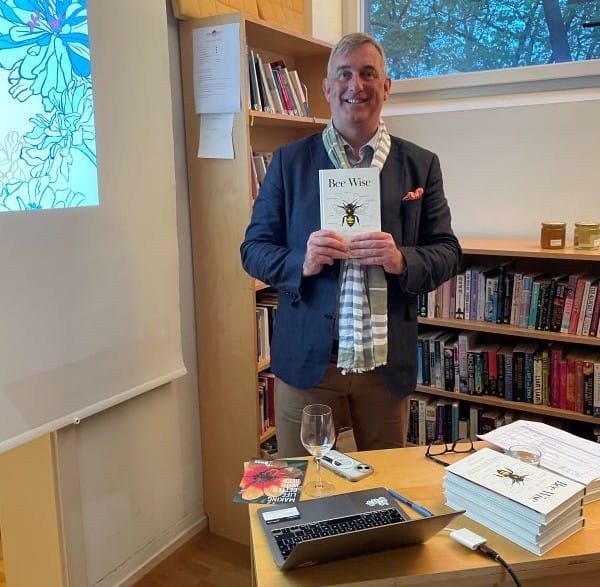
Philip Atkinson. Photo: Bronwen Saunders
I was spellbound to hear about the life cycle of bees. It made me realise that I, too, had been taught my new job by my superior and many years later had transferred that knowledge to two graduates who would again continue the cycle. However, I know now that when I see bees collecting nectar they are already in the last 4 days of their lives. That makes me sad. – Kristina L.
I found it a fascinating talk with many new insights into the world of bees and how we can learn from them. The fact that the queen is not at the top and that the hive is organised around her was particularly interesting. – Roger B.
Bees are certainly fascinating creatures and I learned a lot about them from this talk. But at the risk of going out on a limb, I have to say that I was not convinced by the life lessons they supposedly teach us. The idea that bees, as foragers, teach us the value of diversity, for example, is not very persuasive, given that Homo sapiens are also foragers and, for most of our history, have eaten only whatever was available and in season, hence our varied diet. And just because the queen bee is an egg-laying machine rather than a CEO-type decision-maker can hardly be said to prove the superiority of flat hierarchies.
Philip’s description of the (very short and productive) life of the honeybee, moreover, might equally well serve as an argument for running your company according to Fordist principles: hire hundreds of interchangeable and expendable workers and make them perform the same set of narrowly defined tasks over and over again until they drop dead. But don’t listen to me. Read Philip’s book. – B.S.
I’ve been thinking a lot about this talk and it has become more and more clear to me that humans today tend to live in small communities where they hope to find more of their own kind, that they then do everything they can to prove their individuality and that one thing that is totally “outish” is the verb “to serve”.
So bees seem to be completely backward-looking. Yet they have been successful for millions of years, despite having no resilience, no capacity to fight against new enemies, parasites, climate change etc. It was still interesting to consider what we might learn from bees about business organisations. If anything, it is perhaps to always keep going… Heike O.
Text: Bronwen Saunders