
Centrepoint recently offered its members two Basic First Aid Course sessions in Basel, giving members the opportunity to learn and practise essential first-aid skills. I attended the second session, where eleven Centrepoint members spent two hours taking part in a lively and very hands-on course led by Lucy Oyubo of Hakuna Matata Crew Learning Centre. Lucy started the session by introducing herself and, in a lovely personal touch, welcoming us with Kenyan chai tea that she had made herself.
The course was interactive from the start. We divided into small groups and were given cards, each describing a key step in what to do if we came across someone lying on the ground following an accident. We had to work out the correct order: first check the scene for danger, then see whether the person is responsive and breathing, call 144 and request an AED (Automated External Defibrillator), begin chest compressions and rescue breaths, and finally use the AED as soon as it arrives and wait for the emergency services to take over.
We then practised putting someone into the recovery position before learning the forearm grip, or Rautek grip, used to move someone out of danger. This was definitely one of the more memorable parts of the course: we went outside to Lucy’s car and took turns practising how to pull each other to safety using the grip.
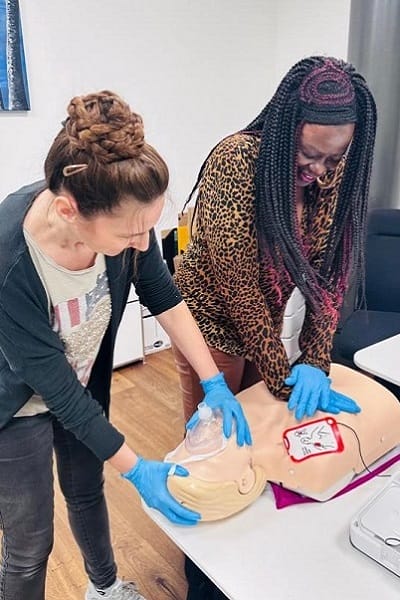
We also walked to the nearby SBB railway station to locate the AED and learn how to activate it. Back in the classroom, we worked in groups matching different emergency services with the appropriate telephone numbers. The key number we learnt was 144 for medical emergencies. The key number we learnt was 144 for medical emergencies. However, it was reassuring to discover that, as Lucy explained, if our minds “go blank”, we can call any of the emergency numbers — such as the police on 117 or the fire service on 118 — and they will transfer us to the correct service.
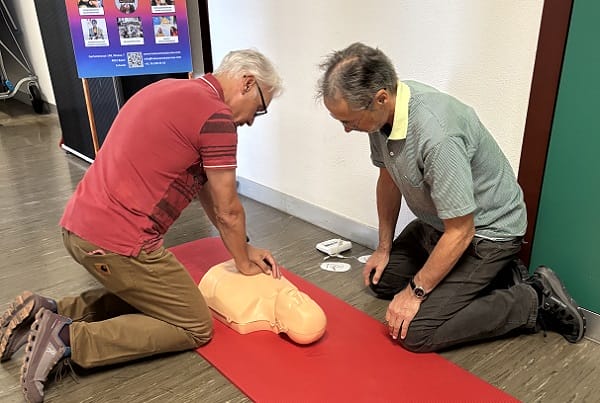
Finally, we practised CPR (cardiopulmonary resuscitation) on training manikins (life-like human models). Most of us were surprised by just how hard and deep the chest compressions need to be. Lucy put on the Bee Gees’ Stayin’ Alive to help us find the right rhythm — a memorable soundtrack for learning a potentially lifesaving skill! It was also surprisingly tiring, so, if possible, people should take it in turns to do compressions until the emergency services arrive.
The course was informative, practical and, thanks to Lucy’s engaging approach, great fun. We left feeling better prepared to respond if we ever find ourselves faced with an emergency.
Text by Maryann Barnacle